


Why is the sky blue?
The answer to childhood's simplest question is also one of physics' most fascinating stories. Sunlight dances with air molecules to paint the sky blue, sunsets red, and eyes every color in between.
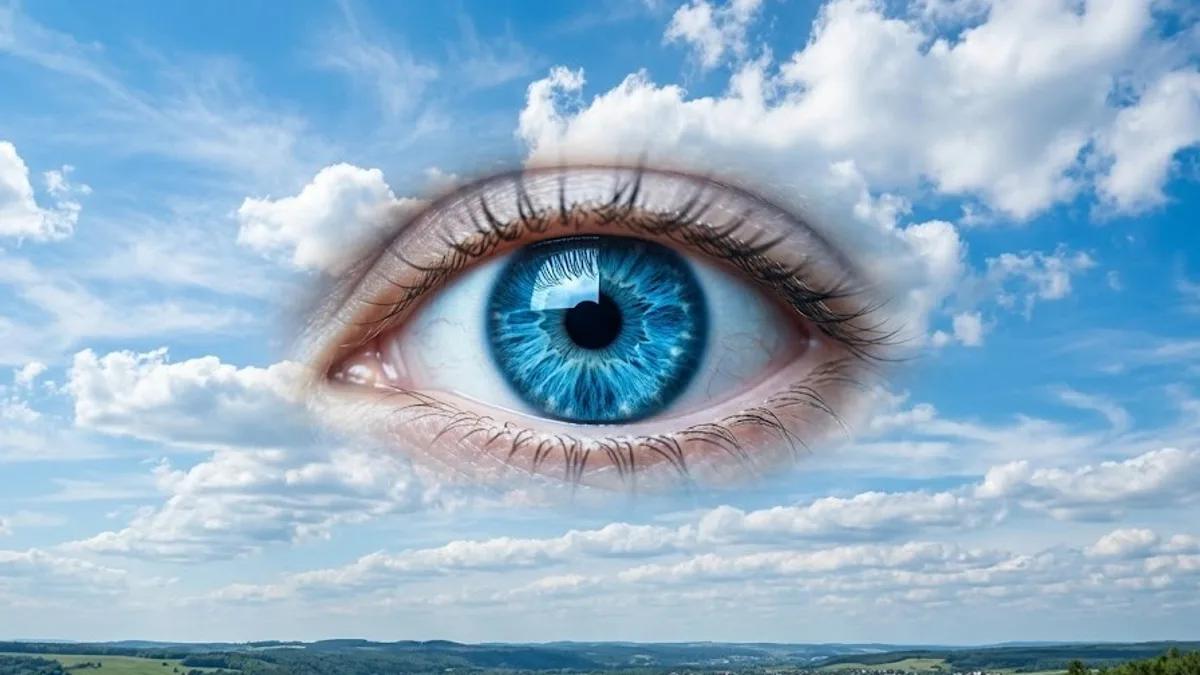
Looking up at the sky on a clear day is like gazing at an infinite canvas painted in blue. A blue so familiar that we rarely stop to wonder why it's there. It's not a pigment, nor a reflection of the ocean, nor a trick of the light — it's the result of an invisible choreography between the Sun and Earth's atmosphere.
In this article, we'll trace that dance molecule by molecule, unravel why sunsets turn red, why your eyes can be blue, and what color the sky is on Mars.
The Solar Spectrum and the Atmospheric Sieve
The Sun emits light in all directions. That light is a mixture of many wavelengths spanning the visible spectrum, which our brains interpret as the colors of the rainbow. When all those wavelengths arrive together, we perceive the light as white.
What Is Sunlight Made Of?
When we say that sunlight contains "all the colors of the rainbow," we are really talking about a continuous distribution of electromagnetic waves with different wavelengths.
Visible light occupies only a tiny portion of the electromagnetic spectrum. Within that range, different wavelengths correspond to different perceived colors: violet lies near the short-wavelength end, red near the long-wavelength end, and all other colors fill the continuum between them.
A beam of white sunlight is therefore not a single color but a mixture of countless wavelengths traveling together. If we pass that light through a prism, the wavelengths separate into the familiar rainbow because each wavelength bends by a slightly different amount.
But sunlight is not perfectly balanced. The Sun does not emit exactly the same amount of energy at every wavelength. Its spectrum resembles the glow of a hot object at about 5,800 K, with the greatest intensity concentrated around the blue-green region of visible light. Some colors are therefore slightly more abundant than others before the light even reaches Earth's atmosphere.

| Region | Wavelength | Approximate fraction |
|---|---|---|
| Ultraviolet | < 400 nm | ~8 % |
| Visible | 400–700 nm | ~43 % |
| Infrared | > 700 nm | ~49 % |
Interestingly, almost half of all the energy emitted by the Sun is in the infrared. Our eyes cannot see it, but our skin perceives it as heat. This observation will be key later for resolving an apparent paradox: if violet light scatters more than blue, why isn't the sky violet?
Our eyes add another layer to the story. Human vision relies on three types of cone cells sensitive to different parts of the visible spectrum. The brain compares their signals and constructs the sensation we call color. White light is not perceived as a separate physical substance; it is the result of many wavelengths stimulating those cones simultaneously.
This means that the color we perceive is never determined solely by the light itself. It also depends on the detector receiving it — in this case, the human visual system. Understanding that interaction between light and perception is essential for answering a deeper question: if violet light scatters even more strongly than blue light, why does the sky appear blue instead of violet?
The sunlight travels through empty space in a straight line for eight minutes until it hits Earth's atmosphere. That's where the magic happens.
The nitrogen and oxygen molecules floating in the air are tiny — much smaller than the wavelength of visible light. When sunlight collides with these molecules, it scatters in all directions. This phenomenon is called Rayleigh scattering, after the British physicist Lord Rayleigh, who described it in 1871[•].
The key is that light does not scatter evenly: the intensity of scattered light is inversely proportional to the fourth power of the wavelength:
The difference is dramatic. Blue light has a wavelength of about 450 nm, while red light is around 650 nm. This means blue light scatters roughly 4.3 times more than red light as it passes through the atmosphere. To take it to the extreme, a violet photon (400 nm) scatters almost 9 times more than a deep red one (700 nm).
Rayleigh's formula hides an almost poetic asymmetry: scattering does not depend slightly on wavelength — it depends on the fourth power. This means if you cut the wavelength in half, scattering doesn't double, or triple: it multiplies by sixteen. It's a tyrannical law that turns small differences into abyssal contrasts.
Imagine you are a blue photon born in the Sun. You travel eight minutes through the void, straight as an arrow. Suddenly, you hit Earth's atmosphere and everything changes: there is no straight line anymore. A nitrogen molecule catches you for an instant and flings you in a completely new direction. Then another. And another. Your trajectory becomes a chaotic zigzag, a cosmic pinball.
Now imagine your brother, a red photon. He also enters the atmosphere, but he is larger, heavier, harder to deflect. He dodges molecules like a rugby player breaking tackles. While you, blue photon, bounce across the sky, your red brother continues almost undisturbed.
The result: when you look toward any corner of the sky, your eyes receive a bombardment of blue photons that were deflected again and again. The sky is not "blue"; the sky becomes blue in the very instant sunlight and the atmosphere perform this dance.
Rayleigh Scattering
By Álvaro Ezequiel Skorepa
Blue scatters quickly, creating the sky color; red passes through and dominates at sunset.
The Lunar Contrast and Treacherous Shadows
One of the best ways to understand the role of the atmosphere is to look at the Moon. There is no atmosphere on the lunar surface to scatter light. This means that even with the Sun shining, the sky appears completely black — even during the lunar day.
The Apollo 11 astronauts experienced this first-hand. They could see the bright Sun and the stars at the same time — something impossible on Earth. But this lack of scattering had a treacherous consequence. Without an atmosphere to scatter light and fill in shadows, every object was split into a blindingly lit zone and an absolutely black shadow. The astronauts soon learned to distrust their eyes: a black shadow could hide a sharp rock or, worse, a deep crater.
The Optics of Sunset
When the Sun sets, its light has to travel through a much thicker layer of the atmosphere. It's like looking through a huge block of blue glass: blue light scatters sideways, out of our direct line of sight to the Sun. That blue light doesn't disappear — it's the same light painting the sky directly overhead and toward the eastern horizon. By the time the direct ray reaches us, it has been impoverished in blues, letting only red, orange, and yellow tones through.
Every sunset is a subtraction in real time. Blue photons are swept away one by one, scattered toward other parts of the sky — the same sky that someone, at that very moment, is watching from another latitude. The blue has not disappeared; it is simply elsewhere, doing its job: making it daytime somewhere else on the planet.
This same principle explains several everyday phenomena:
- Distant mountains: They appear bluish because the column of air between us and the mountain scatters blue light toward our eyes, acting as a natural filter.
- Smoke and haze: They also tend to look bluish for the same reason: fine particles preferentially scatter short wavelengths.
- Clouds are white: Water droplets that form clouds are much larger than air molecules. Rayleigh scattering no longer applies — instead, Mie scattering treats all visible wavelengths nearly equally. That's why clouds are white, or gray if their thickness blocks light.
The Violet Paradox
And yet, the real mystery is not why the sky is blue, but why we perceive it as blue. Because the sky, in reality, is violet. Rayleigh scattering favors shorter wavelengths, and violet is shorter than blue. The "real" sky is a burst of violet that our eyes can barely taste.
But evolution played a game of sensory chess with us:
-
The Sun emits less violet light than blue-green light: as we saw earlier, the solar spectrum is not uniform. The Sun radiates most intensely in the blue-green range, and its violet emission is significantly lower.
-
Our eyes are less sensitive to violet: The human retina has three types of cones — color receptors — sensitive to red, green, and blue. The blue-sensitive cones have very low sensitivity at the violet end of the spectrum. Additionally, the lens absorbs some ultraviolet and violet light, acting as a natural filter.
And there is more. At dusk, when light fades, the Purkinje effect takes the stage: our eyes' peak sensitivity shifts toward blue. In that twilight moment, blue flowers seem to glow from within while red ones die out like dying embers. It is as if our brain, knowing that night is approaching, adjusts its own perception to keep seeing the sky — that blue that is already leaving — for a few more minutes.
The Sky in Miniature: Why Light Eyes Have No Blue Pigment
Blue eyes contain not a single molecule of blue pigment. Those who have them carry a living optical illusion — a phenomenon identical to the one that paints the sky above our heads.
The human iris has two layers. The deep one is a dark curtain of melanin. The superficial one, called the stroma, is a network of microscopic fibers suspended in a liquid medium. When white light enters the eye, longer wavelengths — reds, oranges — pass through this network almost unhindered and are absorbed by the deep melanin. But blue light, with its short, nervous wavelength, collides with the stroma fibers and scatters in all directions. Only it finds its way back out.
It is the same principle as the sky, reduced to an intimate scale: in the sky, air molecules scatter blue; in the eye, the stroma fibers do. In the sky, the dark background is outer space; in the eye, the melanin layer serves as the backdrop. Both are dark canvases onto which a blue haze of scattered light is projected.
Hazel and green-hazel eyes work like a natural barometer of ambient light. When the pupil dilates — in dim light or under excitement — the iris compresses, the stroma fibers crowd together, blue light scattering increases, and the eye becomes greener or bluish. When the pupil contracts under bright light, the golden and brown pigments of the stroma become more exposed and the eye turns more hazel, warmer. It is a celestial cycle in miniature: a dilated pupil behaves like a daytime sky; a contracted one reveals the ochre tones of sunset.
Extraterrestrial Skies
Light scattering is not unique to Earth. On any planet with an atmosphere, starlight interacts with whatever it finds, creating skies of different colors.
Mars is a fascinating example. During the Martian day, the sky has a reddish-orange hue. The thin Martian atmosphere isn't enough for Rayleigh scattering to tint the sky blue. Instead, fine iron oxide dust suspended in the air dominates. This dust absorbs blue light and scatters reddish tones.
But the most fascinating fact is that the Martian sunset is the exact inverse of Earth's. On Earth, the horizon turns red. On Mars, the area around the setting Sun turns blue. This happens because the dust particles, being larger than air molecules, follow Mie scattering, which concentrates some light forward. The same principle that reddens our sunsets is what makes Mars' sunsets blue — a physical mirror between two worlds.
Conclusion
Next time you look at the sky, know that every blue photon reaching your eyes was deflected by an air molecule on its round trip from the Sun. The red sunset, the blue of a distant mountain, the white of clouds, the color of your eyes, and even the Martian sky — all respond to the same physical principles: light, matter, and a mathematical law that reveals hidden beauty in a simple negative exponent.
Science doesn't just explain the color of the sky: it reveals that the entire universe is written in the same language, and that with the right tools we can read it.