


The second awakening: how pregnancy rewires the brain forever
Pregnancy doesn't just transform the body — it rewires the brain. Neural plasticity, fetal microchimerism, and a biological footprint that lasts a lifetime. Science reveals how parenthood reshapes the brain's architecture forever.
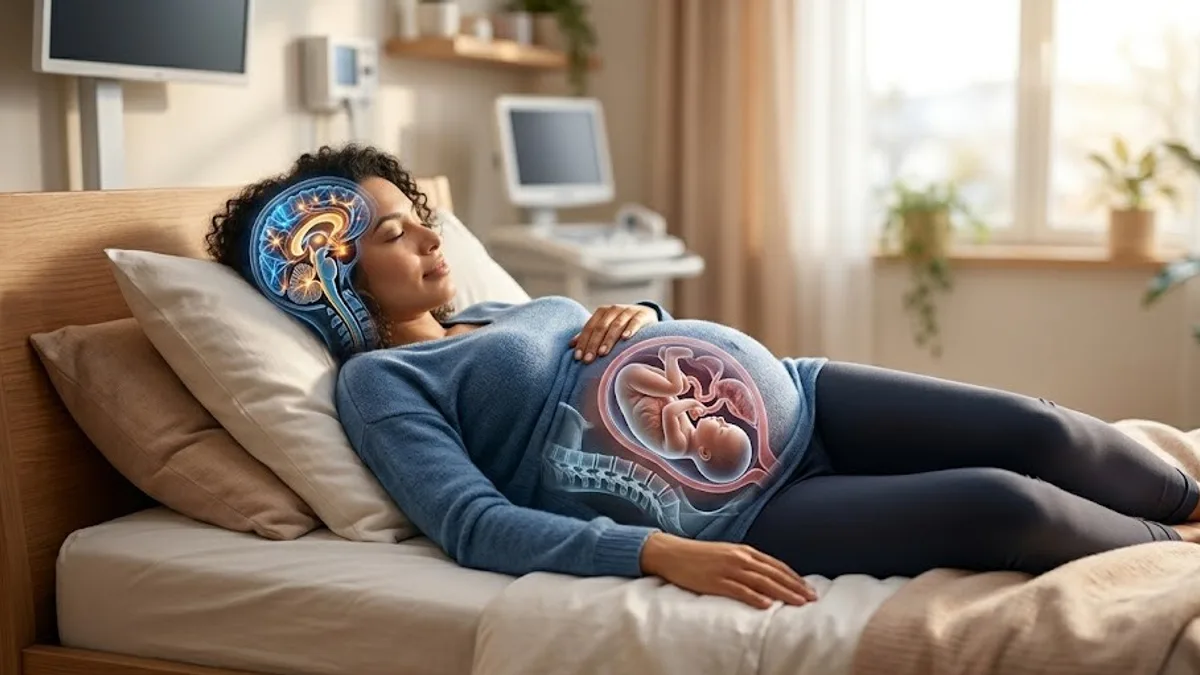
Pregnancy doesn't just transform the body: it rewrites the brain at such a deep level that the changes last a lifetime. Blood volume increases by 50%, the heart works 40% harder, kidney filtration increases, digestion slows from progesterone, and functional lung capacity decreases[•]. But the real revolution happens where you can't see it: in the brain's architecture itself.
Hormones are the architects of this transformation. hCG, progesterone, estrogen, relaxin, prolactin, oxytocin, and cortisol orchestrate both physical and neural changes. Estrogen deserves special attention: it acts on receptors in the hippocampus, prefrontal cortex, and amygdala, increasing dendritic spine density and modulating adult neurogenesis[•][•]. They are the chemical inducers of the plasticity that follows.
The second great peak of neuroplasticity
Imagine a dense, ancient forest. For years it has grown freely, with crisscrossing paths and branches competing for light. Now picture an invisible gardener selectively pruning the less-traveled branches so the main paths receive all the sap. This is what the brain does during pregnancy: it does not lose capacity — it gains purpose.
The gray matter reduction seen on MRIs is not wear and tear, but a finely tuned synaptic pruning orchestrated by the brain's own immune cells: microglia. Stimulated by estrogen and progesterone, these tiny gardeners devour connections that are no longer a priority. The result is a refinement of the circuits underpinning empathy and social cognition — the default mode network — and the more intense this pruning, the more powerful the mother-infant bond after birth[•][•].
In a landmark study, a machine learning algorithm distinguished, without error in that sample, whether a woman had been pregnant based solely on changes in her brain anatomy. Gray matter reduction occurs in default mode network areas — medial prefrontal cortex, precuneus, temporoparietal junction — regions involved in empathy, social cognition, and self-perception[•].
The reward circuit
When exposed to infant stimuli — cries, smell, images — mothers show deep activation in the nucleus accumbens, the same structure involved in desire and addiction. This activation generates a biological priority to respond to the newborn's signals[•][•].
Oxytocin: the bond architect
Oxytocin is far more than the hormone of childbirth and lactation. In the brain, it acts as a genuine neuroplastic factor. During labor and suckling, oxytocin remodels the spines of neurons in the nucleus accumbens and amygdala, sculpting a care circuit that turns a baby's cry into an unignorable call. In the hypothalamus, it promotes new connections between the neurons that produce oxytocin itself — a virtuous cycle that seals the bond each time the baby nurses[•][•].
Stress reprogramming: vigilant calm
The brain also reprograms its stress center. Early in gestation, cortisol rises to mobilize energy, but after birth the hypothalamic-pituitary-adrenal axis becomes more contained: many mothers show an attenuated cortisol response to challenges, enabling a protective serenity. The amygdala — the alarm detector — remains on high alert for infant cries, but its connections with the prefrontal cortex (the seat of emotional regulation) are reinforced. When that dialogue is harmonious, the mother responds with precision; when it falters, the door opens to postpartum anxiety or depression[•][•].
Neurogenesis and memory: the forgetting that is not forgetting
The famous "pregnancy brain" has a real neurobiological basis. In rodents, gestation temporarily halts neurogenesis in the hippocampus — the creation of new neurons — and weaning reactivates it with renewed strength. The postpartum hippocampus does not just recover; it shifts toward socially oriented memory, as if remembering the baby's face and cues becomes the absolute priority[•][•]. It is not deterioration: it is an adaptive refocusing of the brain for motherhood[•].
Fetal microchimerism
One of the most fascinating phenomena is bidirectional cellular exchange. Fetal cells cross the placenta, settle in the mother's organs and brain, and remain there for decades[•]. Fetal-origin cells have been found in the maternal brain with the ability to express neuronal proteins, though their functional integration as fully operational neurons is not confirmed in humans[•]. Whether microchimerism might exert neuroprotective effects against Alzheimer's remains a hypothesis under investigation[•].
Biologically, every mother becomes a genetic chimera: a carrier of her child's cells forever.
When the self is redefined around another
The gray matter reduction in self-perception areas is not a loss: it is an expansion of identity. The maternal brain stops processing the world from an isolated "I" and begins processing from a "we." What was once a personal threat now affects two. What was once an individual joy now multiplies.
If something bad happens to the child, the mother experiences it as her own. If something good happens, she feels it too. This is not metaphor or romantic exaggeration: it is the result of synaptic reconfiguration that literally expands the boundaries of the self to include another being[•][•].
A mother's love is not poetry: it is the result of a brain that reconfigured itself to prioritize another being above itself.
Evolutionary perspective
This biological substrate is not unique to humans. In placental mammals, the same circuits activate with motherhood. In rats, the hormonal surge of childbirth modifies neural receptors so that pup stimuli acquire absolute salience[•]. In male marmosets, direct caregiving reduces testosterone and raises prolactin receptors in the brain, producing changes nearly identical to maternal ones[•]. Direct caregiving remodels the brain without going through gestation.
Plasticity in fathers and adoptive mothers
Pregnancy is not the only path. Studies in fathers and adoptive mothers reveal that direct, prolonged interaction with the baby induces significant brain changes. Daily caregiving reduces testosterone, increases oxytocin and prolactin, and produces gray matter increases in prefrontal and temporal areas[•][•]. Brain plasticity does not understand gender: it understands presence and dedication.
Long-term biological footprint
The reconfiguration is not temporary. Follow-up studies confirm that even 6 years after childbirth, the maternal brain has not returned to its pre-pregnancy baseline[•]. Research in women up to 70 years old reveals sustained structural differences between mothers and non-mothers, associated with indicators of lower brain age in old age[•]. This is not a simple causal relationship: it depends on socioeconomic factors, social support, and the continuous cognitive stimulation that child-rearing provides.
The epigenetic fingerprint: why every motherhood is unique
None of these transformations is identical between two mothers, because experience leaves chemical marks on DNA. Social support, perceived stress, and environment modulate the methylation of genes that regulate the stress axis and oxytocin. This epigenetic layer explains why the same biological revolution can be experienced as a crisis or as empowerment, and makes each motherhood a unique, unrepeatable brain architecture[•][•].
How to boost neuroplasticity
Beyond pregnancy, certain habits enhance brain plasticity. Ordered by scientific impact:
-
Aerobic exercise — increases BDNF and hippocampal volume, improving memory and delaying cognitive decline[•].
-
Deep sleep — during slow-wave sleep, the brain consolidates memories, clears toxins, and reorganizes synaptic connections[•]. In the postpartum period, sleep fragmentation is not a simple deficit: it temporarily alters default mode network connectivity and, in doing so, appears to favor the consolidation of baby-related memories. Extreme fatigue, far from being an absolute enemy, is part of the chisel that sculpts a maternal brain hyperspecialized for nighttime care.
-
Continuous learning — studying a language, playing an instrument, or acquiring a new skill generates new neural connections[•].
-
Nutrition — omega-3 fatty acids, polyphenols, and a healthy gut microbiome promote neurogenesis and reduce neuroinflammation[•].
Conclusion
All these mechanisms — immune pruning guided by microglia, oxytocin building circuits, vigilant calm in the face of stress, neurons being born and reoriented, sleep that sculpts, epigenetics that personalizes — converge into a plastic symphony that defines the maternal experience beyond the obvious. Pregnancy does not just add a life to the world: it reshapes the brain so that mother's world orbits, with biological precision, around that life.
And it demonstrates that this bond is not exclusive to gestation: presence, dedication, and active caregiving can awaken the same circuits in anyone who chooses to parent.