


The golden angle: when nature does math
Nature leaves nothing to chance. Behind every leaf and petal arrangement lies the golden angle of 137.5°, a mathematical formula that maximizes efficiency with millimeter precision. A journey from roses to sunflowers revealing nature as the first engineer.
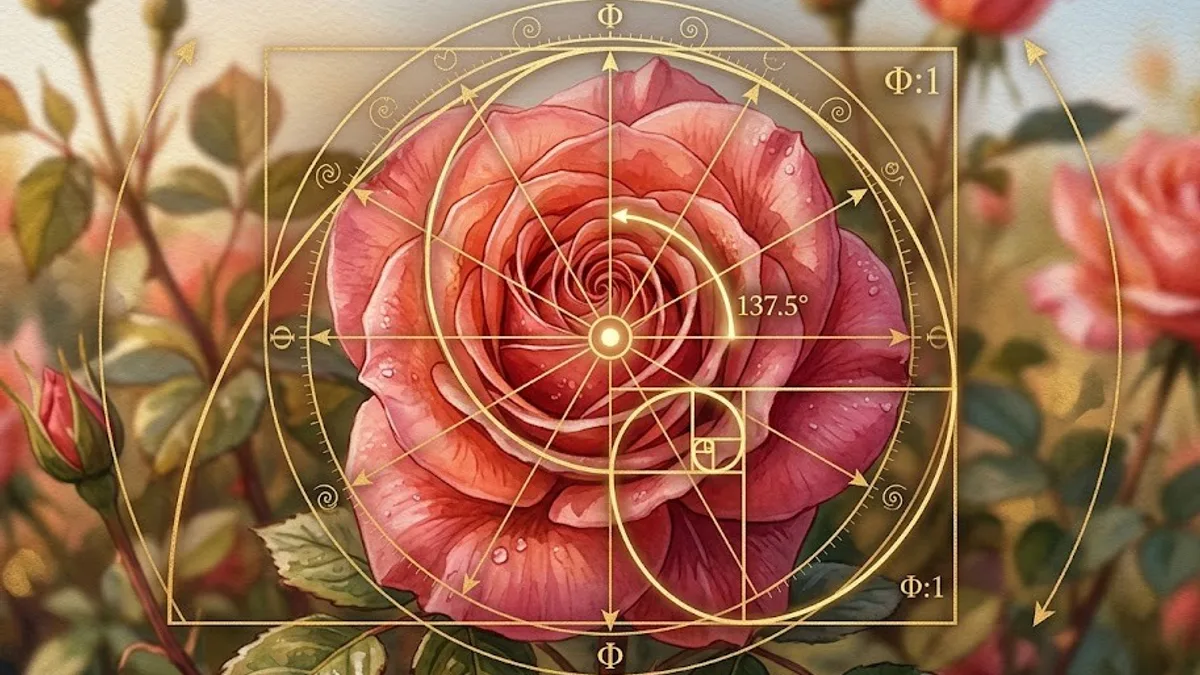
Imagine for a moment that you are a plant. You need to arrange your leaves around the stem so that each one receives the maximum amount of sunlight, without leaves casting shadows on each other. And you must do this with the least amount of "material" possible, because energy is valuable and you cannot waste it.
How do you solve it? With an angle of 137.5 degrees.
This number, known as the golden angle or Fibonacci angle, is one of the most elegant and efficient solutions nature has found over millions of years of evolution. And as we will see, it is also one of the best demonstrations that nature was the planet's first engineer.
In the simulation below, each dot represents a new leaf or seed. The first appears at the center. The next rotates by a set angle and moves slightly outward. The next rotates again and moves further out. This repeats 400 times, building the spiral. Try different angles with the presets or sliders — when the angle is irrational like 137.5°, dots never overlap.
Golden Angle (φ)
Creates the densest possible packing without overlap. Every leaf or seed gets maximum light and space.
Origin: 360° × (2 − φ) ≈ 137.5°, where φ = (1+√5)/2
Found in: Sunflowers, pinecones, daisies, roses, Romanesco broccoli, artichokes
1.00 = constant spacing (natural). Lower = points cluster at edge. Higher = points cluster at center.
What is the Golden Angle?
The golden angle arises from dividing a full circle (360°) by the golden ratio φ (phi, approximately 1.618), but not exactly: it is actually derived from the complementary angle.
To understand it:
- Take a 360° circle
- Divide it into two parts following the golden ratio: the larger arc measures 360°/φ ≈ 222.5°
- The smaller arc, the angle we are looking for, is 360° − 222.5° = 137.5°
Mathematically:
This angle is intimately related to the Fibonacci sequence (1, 1, 2, 3, 5, 8, 13, 21, 34, 55, 89...). As we advance in the sequence, dividing one number by the next approaches φ ≈ 1.618. The golden angle is precisely the one resulting from this proportion applied to the circle.
Why This Angle and Not Another
The answer seems obvious: because it works. But the more interesting question is how nature "discovered" that 137.5° was the optimal solution. The answer leads us to a fascinating experiment.
In 1992, physicists Stéphane Douady and Yves Couder demonstrated that phyllotaxis (the arrangement of leaves) does not require plants to "know" mathematics. They placed drops of a magnetic fluid in a dish of oil, making them emerge periodically from the center using a magnetic field. The drops repelled each other, and as new drops emerged, the system naturally sought the position of least repulsion. The result: the drops spontaneously organized at an angle of 137.5°.
The experiment showed that the golden angle emerges from a simple physical principle: repulsion between elements born in sequence. When a new element appears, physical forces push it to the farthest point from existing ones. And when that process repeats indefinitely, the angle that minimizes cumulative overlap is precisely 137.5°.
Why It Works: Irrationality
The key is that 137.5° is an irrational number in terms of circle fractions. If we use 180° (half the circle), leaves align in two opposite rows. If we use 120° (one third), they align in three. The problem is that any rational fraction produces alignments that eventually overlap.
The golden angle, being irrational, never repeats exactly. Each new leaf appears in a position that has not been occupied before. And here is the most fascinating part: φ is not just any irrational number. It is the most irrational of all.
The Most Irrational Number
Mathematically, any irrational number can be expressed as a continued fraction. The one for φ is the simplest possible: all its terms are 1.
This means φ converges more slowly than any other number when approximated by fractions. In other words, φ is the number that most resists being approximated by a simple fraction. And that is why it produces the most homogeneous distribution possible: it never falls into a repetitive pattern.
Nature did not choose a pretty number. It chose the number that maximizes space occupancy efficiency.
The Dance of Fibonacci Numbers
When you rotate by 137.5° again and again, something magical happens: the Fibonacci numbers appear on their own.
After 3 rotations, you have turned 3 × 137.5° = 412.5°, which is 52.5° past one full turn. After 5 rotations: 5 × 137.5° = 687.5°, which is 327.5° (or 32.5° short of two full turns). After 8 rotations: 8 × 137.5° = 1100°, exactly 3 full turns plus 20°. After 13 rotations... you will notice that the accumulated angles approach whole numbers of turns following the Fibonacci sequence: 3, 5, 8, 13, 21, 34, 55, 89...
That is, each Fibonacci number tells us every how many leaves we find one that almost aligns with the starting leaf. This "almost" is what creates the visible spirals we see in sunflowers and pinecones.
The Mathematics of Spirals
When you look at a sunflower, you see two families of spirals rotating in opposite directions. One family is more pronounced than the other. Why?
Each spiral connects seeds that are separated by a fixed number of positions in the growth sequence. If you count the spirals clockwise and counterclockwise, you will always get two consecutive Fibonacci numbers. In a typical sunflower: 21 and 34. In a large one: 55 and 89. In the giants: 89 and 144.
This pattern is not random: the ratio between the two numbers is the best rational approximation of φ. 21/34 ≈ 0.6176, 34/55 ≈ 0.6182, 55/89 ≈ 0.6180. Each pair gets closer to 1/φ, the golden fraction.
Nature as the First Engineer
Long before humans studied energy efficiency, resource optimization, and structural design, nature was already practicing them with a perfection that modern engineering is only beginning to understand.
Roses and Their Petals
Observe a rose. Most wild roses have 5 petals — a Fibonacci number. But more fascinating is how those petals arrange themselves around the center. If you look at a rose from above, you will see that each petal grows at an angle of approximately 137.5° relative to the previous one, creating that perfect spiral we so admire.
But the rose does not "know" mathematics. The cells in the meristem (the plant's growth tissue) organize following physical principles of repulsion and compression. When a new cell emerges, physical forces push it to the point of least resistance, which coincidentally corresponds to the golden angle. Nature does not calculate: it optimizes.
Sunflowers and Perfect Packing
Perhaps the most impressive example of the golden angle in action is the sunflower (Helianthus annuus). When we look at a mature sunflower head, we see two families of spirals rotating in opposite directions.
A typical sunflower has 21 spirals in one direction and 34 in the other. Both are consecutive Fibonacci numbers. In larger sunflowers, we can find 55 and 89, or even 89 and 144. This arrangement allows packing the maximum number of seeds in the minimum possible space, a problem engineers call packing optimization.
The scale is staggering: a sunflower can hold over a thousand seeds, all arranged without overlap. No human engineer has ever packed a thousand circles into a disk with such efficiency.
Pinecones and Artichokes
Pineapples show a similar spiral pattern. Count the scales on a pineapple and you will likely find 8 spirals in one direction and 13 in the other. Artichokes are another classic example: their bracts organize following the golden angle with a precision that seems almost mechanical.
Pinecones have an additional fascinating property: their scales open and close with humidity to release seeds under optimal conditions. But the spiral arrangement of those scales remains the same. The structure is optimized for both packing and function.
Succulents and Light Capture
Succulents, like the popular Echeveria or Aloe vera, arrange their leaves in rosettes that follow the golden angle. This arrangement maximizes sunlight capture in arid environments where every drop of energy counts. The rosette acts as a natural solar panel, and the older leaves at the base receive light through the gaps left by the upper leaves.
The analogy with solar panels is not accidental: engineers designing concentrated solar panels study succulent rosettes to improve their designs.
Romanesco Broccoli
Perhaps the most visually striking example is Romanesco broccoli (Brassica oleracea). Each of its florets is a miniature version of the whole head, organized in logarithmic spirals that follow Fibonacci numbers. It is a natural fractal: the same pattern repeats at different scales. Nature does not just use the golden angle to organize individual elements — it nests it across multiple levels of organization.
Beyond Plants: Universal Patterns
Hurricanes
The spiral shape of a hurricane seen from satellite follows a logarithmic spiral, very close to the golden spiral. Clouds organize following fluid dynamics principles that, under certain conditions, produce angles very similar to the golden angle. It is the same physical organizing principle as in galaxies and plants: a rotating system where new elements are added from the center.
Spiral Galaxies
Our own Milky Way and many other spiral galaxies show arms following logarithmic spiral patterns. Although the relationship with the golden angle is not exact, the organizing principle is the same: matter distributes following angles that optimize gravitational stability.
What is fascinating is that the same mathematics describing seed arrangement in a sunflower also describes, with slight variations, the structure of galaxies containing billions of stars. The laws of physics are the same at all scales.
DNA
The DNA molecule, with its famous double helix, has a structure containing proportions close to the golden ratio. The complete turn of the helix measures approximately 34 angstroms in length and 21 angstroms in width. 34 and 21 are consecutive Fibonacci numbers.
This is not a mystical coincidence. The stability of the double helix depends on precise geometric relationships between base pairs. The proportions that maximize structural stability turn out to be close to the golden ratio because, just as in plants, φ represents an optimum of packing and organization.
The Human Imprint: the Golden Ratio in Culture
The golden ratio has fascinated humans for millennia. It has been claimed to appear in the Parthenon, the Egyptian pyramids, the Mona Lisa, and countless works of art. The reality is more nuanced: many of these examples are exaggerations or popular myths.
However, there is solid evidence that certain composers like Debussy and Bartók consciously used the golden ratio in their works. Violinist and composer Joseph Sauveur discovered in the 18th century that vibrating strings produce harmonics whose frequencies follow patterns related to the golden section. And in architecture, Le Corbusier designed the Modulor, a proportion system based on φ that he applied in buildings like the Unité d'Habitation.
The crucial difference: humans consciously choose φ because we find it aesthetically pleasing. Plants arrive at φ because it is physically inevitable.
Biomimicry: Learning from Nature
Biomimicry is the discipline that studies nature's designs for application in human engineering. And the patterns of the golden angle and Fibonacci have inspired numerous innovations.
Solar Panels
The most efficient solar panels on the market mimic the arrangement of leaves on a branch. By placing solar cells following a Fibonacci spiral, light capture is maximized throughout the day. An Australian company, Solar Botanic, has developed "solar trees" whose photovoltaic "leaves" are arranged following the golden angle, capturing up to 30% more energy than traditional flat panels.
Wind Turbines
Researchers have designed wind farms where turbines are placed following Fibonacci patterns, optimizing the airflow between them. The result is up to 20% increase in energy efficiency compared to traditional grid arrangements. The reason is the same as in plants: irrational patterns avoid destructive interference between neighboring elements.
Architecture
Spanish architect Santiago Calatrava has used principles of the golden angle and natural spirals in numerous works, from the Woman's Bridge in Buenos Aires to the City of Arts and Sciences in Valencia. At the Príncipe Felipe Science Museum, the skeletal structure of the roof follows spirals reminiscent of whale ribs, optimizing load distribution exactly as a skeleton does.
Blade Design
Fan blades, ship propellers, and aircraft turbine blades are increasingly designed mimicking the shape of maple seeds (samaras), which spiral following principles close to the golden angle to maximize lift and minimize noise. NASA aerospace engineers have studied the aerodynamics of maple seeds to design more efficient drone wings.
Nature's Lesson
The golden angle teaches us something profound: mathematics is not a human invention, but a discovery. Nature has been solving optimization problems for millions of years with an elegance that our best minds are only beginning to understand.
Every rose, every sunflower, every pinecone is a monument to evolutionary efficiency. Nature does not need calculators or equations: it simply tries, fails, learns, and optimizes over generations. And the result is so perfect that we humans call it "beauty."
Beauty in nature is not an accident. It is the signature of efficiency.
Next time you see a flower, remember that you are observing millions of years of mathematical optimization. And that same mathematics, the golden angle, is being studied in the most advanced engineering laboratories in the world to design more efficient solar panels, stronger buildings, and quieter turbines.
Nature was the first engineer. And it remains the best.